

Safe Drinking Water is a Human Right

Daniel Shafer • July 23, 2022

22 July 2022       By Janina Rhea A. Lazo-Cruz Consulting Engineer for Nikua Training Center


"Water, water everywhere, and not a drop to drink."


Point of Use Solutions


The poem by Samuel Taylor Coleridge is said to have been inspired by the Sargasso Sea. Few people have experienced this phenomenon first-hand, but many of us have experienced the same problem while traveling to remote areas with unreliable access to safe drinking water. According to the Center for Disease Control and Prevention, over 1 billion people do not have reliable access to safe water.  This can lead to a multitude of health concerns including cholera, diarrheal diseases, dysentery, typhoid fever and hepatitis A. Good thing though, there are several Point of Use technologies that can provide adequate treatment for drinking water. Below are a few commonly used water treatment technologies for use in areas without reliable access to safe drinking water.


Boiling is the most frequent method of disinfecting water, and WHO considers it to be "the simplest and most effective technique to destroy all disease-causing pathogens." It allows for pasteurization of microorganisms, which reduces the overall microbial load in the water. However, depending on the fuel used, it may be ecologically and economically unsustainable.


Chlorine is a low-cost, easy-to-use water treatment technology that disperse disinfectant efficiently against waterborne germs and diseases. It has been shown to be an excellent supplementary precaution when utilizing basic filtering, such as a slow sand filter, since it successfully eliminates disease-carrying bacteria, particularly when turbidity has been decreased.


Electric dosing pumps are a typical chlorination method used all over the world. This method injects a predetermined amount of liquid chlorine into community water distribution networks. Although effective in wealthier areas, technologies that rely on power sources and complicated designs are prone to failure in rural and impoverished communities due to unpredictable power and a lack of infrastructure. Furthermore, chlorine is ineffective against parasites or for reducing turbidity, and it can leave a strong odor and/or an unpleasant taste.


Vestergaard Frandsen, an international humanitarian technology business located in Switzerland, created the LifeStraw, a portable water filter. It is simple to use, adaptable to a wide range of situations, and do not require energy or moving parts. Like a drinking straw, water flows through the cylindrical filter due to a pressure differential produced by suction. Water flows through several chambers in the LifeStraw's 9-inch length. First, the water passes through layers of mesh with micrometer-sized gaps, capturing the bulk of microorganisms and turbidity causes. Following the mesh, the water enters a chamber containing iodine-coated beads, which kill any remaining germs. Finally, the water is passed through a chamber containing active carbon to eliminate the iodine flavor.


The LifeStraw family unit exceeds WHO’s requirements for "very protective" microbial water purifiers. However, it has downsides such as a limited lifetime of up to three years, poor capacity, and Outsourced technology built in undeveloped regions using locally scarce resources.


Water disinfection can also occur with the help of solar energy. When left out in the sun, the Puralytics SolarBag transports and purifies 3.5 L of water and features an indicator that tells the user when the water is safe to drink. On a bright day, the filter will finish purification in 2-3 hours, whereas on an overcast day, it would take 4-6 hours. The SolarBag's interior features a nanotechnology coated mesh that activates when it comes into touch with UV rays from the sun. This sets off five distinct photocatalytic reactions in the water.


1.      Photocatalytic oxidation – an oxidation that uses hydroxyl radicals generated by light-activated molecules.


2.      Photolysis – the disruption of molecular bonds in many chemical substances when subjected to certain wavelengths of light.


3.      Photocatalytic reduction – conversion of a harmful pollutant into a less toxic form using a photocatalyst.


4.      Photoadsorption – the absorption of pollutants to a surface caused by light, such as heavy metals.


5.      Photodisinfection – disinfection of water by destroying DNA molecules with several light bands.


Although photodisinfection is easy and often efficient, it does have certain drawbacks. The method, most notably, has no effect on the presence of chemical pollutants. Furthermore, turbid water scatters sunlight and can prevent disinfection from occurring deeper than a few millimeters.


Slow sand filtration has been used as a water treatment method for hundreds of years because it is particularly successful at eliminating particles, germs, pathogens, and undesirable compounds. David Manz invented the BioSand Filter (BSF) in 1990 as a household-sized version of slow sand filtration. It was created for families in places with insufficient water treatment and delivery infrastructure.


A concrete body, filtering material, and a PVC pipe system make up the BioSand Filter. Water is put into the filter's top, passes through the media, and is then propelled up the PVC pipe to the exit. This device removes contaminants through the following mechanisms:


•        Mechanical trapping: Small particles, such as microorganism and silt, are trapped within the spaces of the sand grains.


•        Absorption: Suspended substances in the water attach to the surfaces of the sand particles due to molecular forces.


•        Biologically active layer: This layer comprises of a group of organisms that increases the filter’s ability to remove bacteria and parasites. This layer assists in capturing organic matter, particles, a variety of bacteria and pathogens, and also heavy metals such as iron and arsenic. 


The technologies described above are widely utilized across the world. Aside from these, Nikua Training Center offers affordable solutions for those who inhabit such areas or are concerned about their family's safety should disaster strike.

Caribou with large antlers on a grassy plain, mountains in background, under a hazy sky.
By Daniel Shafer February 28, 2021
“Either you are part of the solution, or you are part of the problem.” ~ Eldridge Cleaver Here are the top 5 SEO practices to start with: For investors, climate change poses both financial risk and opportunity. The USA and the global economy are beginning the transition to a lower-carbon economy, which is estimated to require about $1 trillion USD of investments each year for the foreseeable future. New investment opportunities in energy efficiency and renewable energy are opening. At the same time climate-related financial risk for industry is increasing. Companies, communities, and agriculture are affected by the physical impacts of climate change, while climate policy and new technologies are shifting the risk-return profile for American business. A 2015 study by the Economist Intelligence Unit titled, “The cost of inaction: Recognizing the value at risk from climate change” estimates that the discounted net present value of expected losses to global manageable physical assets is $4.2 trillion USD, which is roughly equal to total shareholder value of all the world’s listed oil and gas companies. We should ask; what value are we protecting by continued inaction? Consider the financial impact after oil, coal, and natural gas companies trash $4.2 trillion of our assets. People will have no legal recourse when fossil fuel producing companies loose value, as we rid ourselves of the cause of environmental damage. The Economist study highlights that “much of the impact on future assets will come through weaker growth and lower asset returns across the board.” Investors may not be able to avoid climate-related risks by moving out of certain asset classes as a wide range of asset types could be affected. The first principle of investing is to preserve capital. The asset management industry and investors should prepare for expected losses due to climate change, in the context of declining economic growth and lower asset returns. Global warming is both immediate and long-term, with substantial risk of extreme events which have become more frequent, including devastating tropical storms fueled by increased atmospheric energy. Just last summer in the Pacific NW, forest fire storms wiped out entire towns while forest fire ash fell like snow at my house. I have worked for over a decade on renewable energy, economic sustainability, and climate change. But now, its personal. Lending, insurance underwriting, and investment decisions increasingly tie to climate-related risk from drought, floods, powerful storms, and loss of agricultural productivity. Forward looking leadership on climate adaptation is the minimum needed to allocate capital spending toward a smooth transition to a lower-carbon economy. For many people, environmental sustainability equals survive-ability. The Brookings Institute reports that, “Regions already struggling economically will be hit the hardest by climate change. The worst-off USA counties in terms of economic vitality, labor market, income, and share of national GDP will experience the most damage. Counties that will be hit hardest by climate change tend to be in the South and Southwest regions of the United States, with over half of those located in Florida, Louisiana, North Carolina, South Carolina, and Texas. Low-income Americans with few marketable skills are often unable to migrate in response to climate change, which exposes them to hardship. While high technology solutions to climate change are often developed in prosperous counties in the Northeast, upper Midwest, and Pacific regions, where communities are less exposed to climate damage.” Brookings Education Environmentally progressive companies create new business opportunities through innovation while attracting and retaining the best talent. The Sustainable Leaders Forum points out that companies engaged in adaptation and mitigation of climate change prosper financially in the immediate term because financial savings accrue through streamlining & efficiencies. According to the study “The Future of Business Citizenship” attracting the brightest talent depends on a clear commitment to environmental stewardship. Accelerating business growth is achieved through innovation by front-line employees who have day-to-day knowledge of customers, facilities, logistics, production operations, and procurement in a program that harnesses employee knowledge and reports results on a regular basis. According to the study 4 out of 5 Millennials say they want to be an active part of the change they want to see in the world and by 2025, 75% of the global workforce will be millennials. One respondent said, “Businesses have the resources, collective intelligence, and technology to make a difference.” Companies that enlist employees to innovation programs generate better ideas and implement them more effectively. The approach to climate change can go beyond operational effectiveness and become strategic. Some firms will find opportunities to enhance or extend their competitive position by creating products that exploit climate-induced demand, while innovating to produce a genuine competitive advantage.
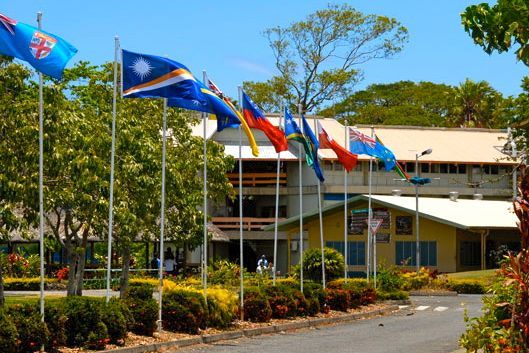
Flags of various nations fly in front of a building with a yellow facade and a green lawn.
By Daniel Shafer February 9, 2021
The advanced biofuel portion of the product development plan at Nikua Training Center is moving forward.